

NCERT Solutions Class 12 Biology Chapter 13 - Organisms and Populations
Complete Solutions for Questions 1-31 | CBSE Class 12 Biology
1
Question
How is diapause different from hibernation?
Answer
Hibernation is a phenomenon in which animals avoid stress by winter sleep during unfavorable conditions (usually winter), such as bears. Animals enter a state of dormancy, reducing their metabolic rate and body temperature to conserve energy during harsh winter months.
Diapause is a state of suspended development seen in many aquatic species (e.g., zooplanktons) during either summer or winter under unfavorable conditions. It can occur in both seasons and involves a temporary halt in development rather than just reduced activity.
2
Question
If a marine fish is placed in a freshwater aquarium, will the fish be able to survive? Why or why not?
Answer
No, a marine fish in a freshwater aquarium will not survive because:
- Water will enter its body via endosmosis due to the concentration gradient
- It lacks the mechanisms to absorb salt as freshwater fish do
- Its habit of drinking water will lead to excess water intake
- This disrupts osmolarity, ultimately leading to cell damage and death
3
Question
Most living organisms cannot survive at temperature above 45°C. How are some microbes able to live in habitats with temperatures exceeding 100°C?
Answer
Most living organisms cannot survive above 45°C due to:
- Enzyme denaturation at high temperatures
- Protoplasm precipitation
However, some microbes (Archaebacteria) can live in habitats exceeding 100°C because they have:
- Branched chain lipids in their cell membranes that reduce fluidity
- Heat-tolerant enzymes that maintain their structure at high temperatures
- Specialized protein structures that resist denaturation
4
Question
List the attributes that populations, but not individuals, possess.
Answer
The attributes that populations possess but individuals do not are:
- Population density - Number of individuals per unit area
- Population growth - Rate of change in population size
- Mortality (death rate) - Number of deaths per unit time
- Natality (birth rate) - Number of births per unit time
- Sex ratio - Proportion of males to females
- Age distribution - Proportion of individuals in different age groups
5
Question
If a population growing exponentially doubles in size in 3 years, what is the intrinsic rate of increase (r) of the population?
Answer
For exponential growth, when population doubles:
Using the formula: t = ln(2)/r
Where t = 3 years, ln(2) = 0.693
Therefore: r = ln(2)/t = 0.693/3 = 0.231 per year
The intrinsic rate of increase (r) is 0.231 per year or 23.1% per year.
6
Question
An orchid plant is growing on the branch of mango tree. How do you describe this interaction between the orchid and the mango tree?
Answer
The interaction between an orchid and the mango tree is commensalism.
In this relationship:
- The orchid (epiphyte) benefits by obtaining shelter, support, and better access to sunlight
- The mango tree is neither harmed nor benefited by the presence of the orchid
- The orchid uses the tree only as a platform and does not derive nutrients from it
7
Question
What is the ecological principle behind the biological control method of managing pest insects?
Answer
The ecological principle behind biological control is the use of natural enemies to control pest populations.
This principle operates through:
- Predation - Predators consume pest insects
- Parasitism - Parasites weaken or kill pest insects
- Competition - Natural enemies compete with pests for resources
- Disease - Pathogens cause diseases in pest populations
This method maintains ecological balance and reduces dependency on chemical pesticides.
8
Question
Distinguish between the following:
- (a) Hibernation and aestivation
- (b) Ectotherms and endotherms
Answer
(a) Hibernation vs Aestivation:
| Hibernation | Aestivation |
|---|---|
| Winter dormancy (winter sleep) | Summer dormancy (summer sleep) |
| Animals rest in warm places | Animals rest in cool, shady places |
| Lasts for entire winter season | Generally lasts for hot, dry daytime |
| Example: Bears, ground squirrels | Example: Lungfish, desert animals |
(b) Ectotherms vs Endotherms:
| Ectotherms | Endotherms |
|---|---|
| Cold-blooded animals | Warm-blooded animals |
| Cannot regulate body temperature | Can regulate body temperature |
| Body temperature changes with environment | Maintain constant body temperature |
| Exhibit hibernation and aestivation | These activities are uncommon |
| Less active | More active |
| Example: Reptiles, amphibians, fish | Example: Birds, mammals |
9
Question
Write a short note on:
- (a) Adaptations of desert plants and animals
- (b) Adaptations of plants to water scarcity
- (c) Behavioural adaptations in animals
- (d) Importance of light to plants
- (e) Effect of temperature or water scarcity and the adaptations of animals
Answer
(a) Adaptations of desert plants and animals:
Desert Plants:
- Thick waxy cuticles to reduce water loss
- Leaves modified into spines to minimize surface area
- Deep root systems to access groundwater
- Stomata in deep pits or sunken to reduce transpiration
- CAM photosynthesis to conserve water
Desert Animals:
- Concentrated urine to conserve water
- Ability to absorb and reflect heat efficiently
- Burrowing behavior to escape extreme temperatures
- Metabolic water production from fat oxidation
(b) Adaptations of plants to water scarcity:
- CAM pathway for efficient water use
- Sunken stomata to reduce water loss
- Thick cuticle layer for protection
- Deep and extensive root systems
- Leaf modification into spines
- Water storage tissues in stems and leaves
(c) Behavioural adaptations in animals:
- Basking in sun for thermoregulation
- Burrowing to escape extreme temperatures
- Hibernation during winter months
- Aestivation during hot, dry periods
- Migration to favorable habitats
- Nocturnal activity to avoid heat
(d) Importance of light to plants:
- Essential for photosynthesis and energy production
- Controls timing of flowering and fruit formation
- Regulates enzyme function and metabolic processes
- Influences plant growth and development
- Determines plant orientation and movement
(e) Effect of temperature/water scarcity and animal adaptations:
- Behavioral adaptations to reduce water loss
- Burrowing to maintain stable temperatures
- Concentrated urine production
- Protective adaptations like fat layers and fur
- Hibernation during extreme conditions
- Efficient kidney function for water conservation
10
Question
List the various abiotic environmental factors.
Answer
Abiotic environmental factors include:
- Atmospheric factors: Light, temperature, wind, and water
- Lithosphere: Rock formations and soil composition
- Hydrosphere: Water bodies like ponds, rivers, lakes, and oceans
- Edaphic factors: Soil texture, soil water, soil air, soil microorganisms, soil pH, and minerals
- Topographic factors: Slope, altitude, and valley formations
11
Question
Give an example for:
- (a) An endothermic animal
- (b) Ectothermal animal
- (c) An organism of benthic zone
Answer
- (a) Endothermic animal: Monkey (warm-blooded mammal)
- (b) Ectothermal animal: Snake (cold-blooded reptile)
- (c) Benthic zone organism: Angler fish (bottom-dwelling marine fish)
12
Question
Define population and community.
Answer
Population: A population is a group of individuals of the same species inhabiting a particular area at a given time, capable of interbreeding and reproducing among themselves.
Community: A community is an assemblage of several populations of different species coexisting in a particular area and time, showing interaction and interdependence through trophic relationships and other ecological interactions.
13
Question
Define the following terms and give one example for each:
- (a) Commensalism
- (b) Parasitism
- (c) Camouflage
- (d) Mutualism
- (e) Interspecific competition
Answer
(a) Commensalism: An interaction between two species where one species benefits while the other is unaffected.
Example: Clown fish and sea anemone
(b) Parasitism: An interaction where one organism (parasite) benefits at the expense of another organism (host), which is harmed.
Example: Cuscuta (dodder) parasitizing hedge plants
(c) Camouflage: The ability of organisms to blend in with their surroundings to avoid detection by predators or prey.
Example: Leaf-like grasshopper
(d) Mutualism: An interaction between two species where both organisms benefit from the relationship.
Example: Lichen (symbiotic relationship between algae and fungi)
(e) Interspecific competition: Competition between individuals of different species for the same limited resources.
Example: Extinction of Abingdon tortoise due to competition with introduced goats
14
Question
With the help of suitable diagram describe the logistic population growth curve.
Answer
The logistic population growth curve is S-shaped (sigmoid) and represents a more realistic model of population growth than exponential growth.
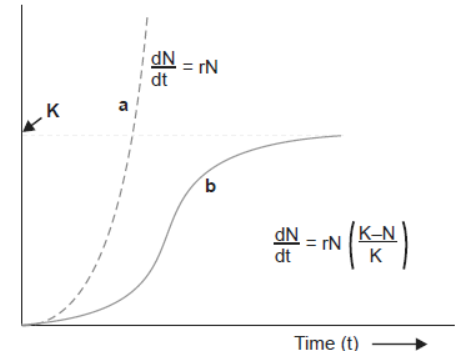
Mathematical equation: dN/dt = rN [(K-N)/K]
Where:
- N = population density at time t
- r = intrinsic rate of natural increase
- K = carrying capacity
Phases of the curve:
- Lag phase: Slow initial growth
- Acceleration phase: Rapid exponential-like growth
- Deceleration phase: Growth rate slows as resources become limited
- Equilibrium phase: Population stabilizes at carrying capacity (K)
This model accounts for environmental resistance and resource limitations that prevent indefinite exponential growth.
15
Question
Select the statement which explains parasitism best.
- (a) One organism is benefited.
- (b) Both the organisms are benefited.
- (c) One organism is benefited, other is not affected.
- (d) One organism is benefited, other is affected.
Answer
The correct answer is (d) One organism is benefited, other is affected.
In parasitism, the parasite benefits by obtaining nutrients, shelter, or other resources from the host, while the host is harmed or negatively affected by the relationship.
16
Question
List any three important characteristics of a population and explain them.
Answer
Three important characteristics of a population are:
1. Population Density
Population density refers to the number of individuals of a species per unit area or volume.
Formula: Population Density = Number of individuals (N) / Area (S)
2. Birth Rate (Natality)
Birth rate is expressed as the number of births per 1,000 individuals of a population per year. It represents the reproductive capacity of the population.
3. Death Rate (Mortality)
Death rate is expressed as the number of deaths per 1,000 individuals of a population per year. It indicates the rate at which individuals are removed from the population.
17
Question
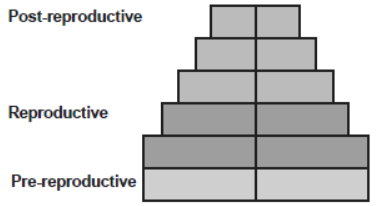
What type of human population is represented by the following age pyramid?
- (a) Vanishing population
- (b) Stable population
- (c) Declining population
- (d) Expanding population
Answer
The correct answer is (b) Stable population.
The age pyramid shows relatively equal proportions of individuals in pre-reproductive, reproductive, and post-reproductive age groups, indicating a stable population with balanced birth and death rates.
18
Question
A sedentary sea anemone gets attached to the shell lining of hermit crab. The association is:
- (a) commensalism
- (b) amensalism
- (c) ectoparasitism
- (d) symbiosis
Answer
The correct answer is (d) symbiosis.
The sea anemone provides protection to the hermit crab with its stinging cells, while the hermit crab provides mobility and food scraps to the anemone. This is a mutually beneficial relationship, which is a form of symbiosis.
19
Question
Which of the following is the most accurate comment on Earth's carrying capacity (K)?
- (a) K is smaller now than it was a thousand years ago.
- (b) The human population is still a long way from K.
- (c) Our technology has allowed us to keep increasing K.
- (d) When it comes to humans, the concept of K is irrelevant.
Answer
The correct answer is (c) Our technology has allowed us to keep increasing K.
Human technological advances in agriculture, medicine, and resource management have effectively increased Earth's carrying capacity for humans by improving food production, reducing mortality rates, and developing more efficient resource utilization methods.
20
Question
Which of the following would be true of a species with an opportunistic life history?
- (a) Members of the species take a relatively long time to reach reproductive age.
- (b) They are regulated mostly by density-dependent factors.
- (c) They produce large numbers of offspring.
- (d) The population usually stabilizes near carrying capacity.
Answer
The correct answer is (c) They produce large numbers of offspring.
Opportunistic species (r-selected species) are characterized by producing large numbers of offspring, reaching reproductive maturity quickly, and having high reproductive rates. They typically exploit unstable environments and have boom-bust population cycles.
21
Question
A particular species of tropical fish has only a few offspring and takes care of them for an extended period. We might also expect the fish population to:
- (a) be controlled mostly by density independent factors.
- (b) show exponential growth.
- (c) live in a harsh environment.
- (d) be relatively stable near carrying capacity.
Answer
The correct answer is (d) be relatively stable near carrying capacity.
This fish exhibits characteristics of K-selected species: few offspring with extensive parental care. Such species typically have stable populations that remain close to the carrying capacity of their environment, with populations regulated by density-dependent factors.
22
Question
Ecological niche is:
- (a) the surface area of the ocean
- (b) an ecologically adapted zone
- (c) the physical position and functional role of a species within the community
- (d) formed of all plants and animals living at the bottom of a lake
Answer
The correct answer is (c) the physical position and functional role of a species within the community.
An ecological niche encompasses both the habitat (where an organism lives) and the functional role (how it interacts with biotic and abiotic factors) of a species within its community. It includes the organism's resource use, behavior, and interactions with other species.
23
Question
Reduction in vascular tissue, mechanical tissue and cuticle are characteristics of:
- (a) mesophytes
- (b) epiphytes
- (c) hydrophytes
- (d) xerophytes
Answer
The correct answer is (c) hydrophytes.
Hydrophytes (aquatic plants) show reduction in vascular tissue, mechanical tissue, and cuticle because they live in water-rich environments where these structures are less necessary. The water provides support and nutrients, eliminating the need for extensive vascular and mechanical tissues.
24
Question
Which of the following is a characteristic of biological community?
- (a) Stratification
- (b) Natality
- (c) Mortality
- (d) Sex-ratio
Answer
The correct answer is (a) Stratification.
Stratification is a characteristic of biological communities where different species occupy different vertical layers or strata within the habitat. Natality, mortality, and sex-ratio are characteristics of populations, not communities.
25
Question
When birth rate equals death rate:
- (a) a population grows rapidly.
- (b) the size of a population remains constant.
- (c) density-dependent limiting factors do not affect the population.
- (d) a population is in danger of extinction.
Answer
The correct answer is (b) the size of a population remains constant.
When birth rate equals death rate, there is zero population growth. The number of individuals added to the population through births is balanced by the number removed through deaths, resulting in a stable population size.
26
Question
According to Allen's Rule, the mammals from colder climates have:
- (a) shorter ears and longer limbs
- (b) longer ears and shorter limbs
- (c) longer ears and longer limbs
- (d) shorter ears and shorter limbs
Answer
The correct answer is (d) shorter ears and shorter limbs.
According to Allen's Rule, mammals from colder climates have shorter ears and shorter limbs to minimize heat loss. This adaptation reduces the surface area exposed to cold, helping maintain body temperature in harsh climates.
27
Question
Which of the following forest plants controls the light conditions at the ground?
- (a) Lianas and climbers
- (b) Shrubs
- (c) Tall trees
- (d) Herbs
Answer
The correct answer is (c) Tall trees.
Tall trees form the canopy layer and control the amount of light reaching the forest floor. Their dense foliage intercepts sunlight, creating varying light conditions that affect the growth and distribution of understory plants.
28
Question
The birth and death rates of four countries are given below. Which one will have the least population growth rate?
| Country | Birth rate/1000 | Death rate/1000 |
|---|---|---|
| M | 15 | 5 |
| N | 25 | 10 |
| O | 35 | 18 |
| P | 48 | 41 |
- (a) M
- (b) N
- (c) O
- (d) P
Answer
The correct answer is (d) P.
Population growth rate = Birth rate - Death rate
- Country M: 15 - 5 = 10/1000
- Country N: 25 - 10 = 15/1000
- Country O: 35 - 18 = 17/1000
- Country P: 48 - 41 = 7/1000
Country P has the lowest population growth rate at 7 per 1000 individuals.
29
Question
According to population scientists, one of the factors responsible for limiting population is the:
- (a) availability of food.
- (b) daily variation of environmental temperature.
- (c) time required for ecological succession.
- (d) life span of members of the population.
Answer
The correct answer is (a) availability of food.
Food availability is a primary limiting factor for population growth. Limited food resources create competition among individuals, leading to reduced birth rates, increased mortality, and ultimately limiting population size according to the carrying capacity of the environment.
30
Question
The logistic population growth is expressed by the equation:
- (a) dt/dN = Nr [K – N/K]
- (b) dN/dt = rN [K – N/K]
- (c) dN/dt = rN
- (d) dN/dt = rN [N – K/K]
Answer
The correct answer is (b) dN/dt = rN [(K – N)/K].
This is the Verhulst-Pearl logistic growth equation, where dN/dt represents the rate of population change, r is the intrinsic growth rate, N is the current population size, and K is the carrying capacity. The term [(K-N)/K] represents the environmental resistance that slows growth as the population approaches carrying capacity.
31
Question
Cuscuta is an example of:
- (a) ectoparasitism
- (b) brood parasitism
- (c) predation
- (d) endoparasitism
Answer
The correct answer is (a) ectoparasitism.
Cuscuta (dodder) is a parasitic plant that attaches to the outside of host plants and derives nutrients from them through specialized structures called haustoria. Since it lives on the external surface of the host, it exemplifies ectoparasitism.
Key Points to Remember
- Diapause and hibernation are both survival strategies but occur in different seasons and organisms
- Population attributes like density, growth rate, and age distribution are emergent properties
- Logistic growth is more realistic than exponential growth due to carrying capacity limitations
- Interspecific interactions include mutualism, commensalism, parasitism, and competition
- Organisms show various adaptations to survive in different environmental conditions
- Allen's Rule and Bergmann's Rule explain morphological adaptations to climate
Additional Information
Chapter 13 of NCERT Class 12 Biology covers fundamental concepts of population ecology and organism-environment interactions. Understanding these concepts is crucial for:
Important Topics Covered
- Population characteristics and dynamics
- Environmental adaptations in organisms
- Interspecific relationships in ecosystems
- Population growth models and equations
- Ecological niches and community structure
These solutions provide comprehensive coverage of all 31 questions with detailed explanations, making them ideal for:
- CBSE Class 12 Biology exam preparation
- NEET entrance exam preparation
- Understanding ecological principles
- Conceptual clarity in population biology